







Database
Ploughshare
|
Title
Ploughshare |
|
Description
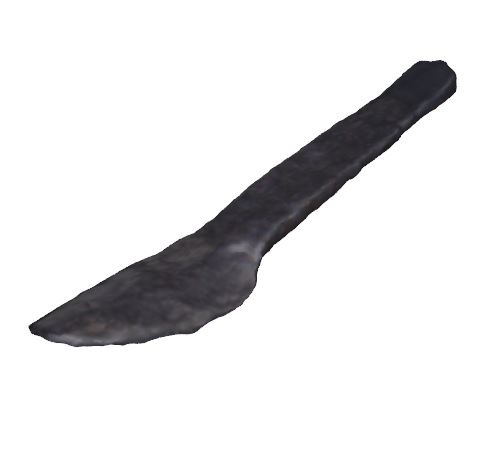
The piece was made from a massive bar which was flattened and bent at one of its ends and has a hook at the other end. At its lower, widened side, the ploughshare is bent longitudinally and transversally, forming a midrib. The ploughshare was attached to the plough’s wood by means of a “D” shaped iron ring. The Dacian plough consisted of a wooden frame and at least two iron components: the ploughshare and the coulter. Its purpose was to increase the sturdiness of the contraption and to increase the work efficiency. The origin of this type of plough lies south of the Danube, in the area of the Balkan Thracians from where the Dacians borrowed it and modified it giving it a specific shape. Find-spot: Grădiştea de Munte – Sarmizegetusa Regia Dimensions: length – 39,4; width – 10,5 cm, thickness – 1,2 cm Material: iron Execution technique: hammering |
|
Geographic coverage
Latitude:45°37′23′′ N ; Longitude: 23°18′43′′ E |
|
Historical Date
1st century BC. - begining of the 2nd century AD. |
|
Time Period
Dacian Era |
|
ID
V 23018 |
|
Scan Type
3D |
|
Scan Format
3DPDF |
|
Digitization Method
|
|
Language
Romanian |
|
Rights
CC BY-NC-ND |
|
Source
National Museum of Transylvanian History, Cluj-Napoca |
|
Data Provider
National Museum of Transylvanian History, Cluj-Napoca |
|
Provider
Romania |


